Why Most Trading Books Stay In The Shelf
The trader has 15 books on the shelf. Mark Douglas. Brett Steenbarger. Van Tharp. Pages are dog-eared. Margins are full. Highlights in 3 colors. Tuesday morning the same setup came up that the books had warned him about. He took the trade anyway. Lost it the way the books said he would.
The shelf is not the problem. The protocol is. Reading is encoding. Trading is retrieval. The trader who runs both on the same day reads fewer books and finishes them harder.
The 3 Layers Behind Reading Without Trading
Most traders read for completion. Finish the book, add it to the count, move to the next one. By year three the shelf is full and the setup-reflex is empty. 15 books read. 3 mechanisms applied. The rest is highlighting. There’s a reason. Why your brain physically cannot trade from highlights goes one layer deeper into the memory-system mismatch.
The mechanism is not “read more books.” The mechanism is apply-pattern. The setup-reflex builds through repeated apply-cycles, not through repeated re-readings. A skip-day stays valid. On a skip-day the trader reads. On a trade-day the trader does not read. The trade-day is for retrieval, not for encoding. The trader who reads the night before the open is loading the wrong system.
3 mechanisms decide whether a book on the shelf becomes a setup at the desk. Each one is well-documented in cognitive science. None of them shows up on the back cover of a trading book.
The first mechanism is the encoding-retrieval asymmetry. Karpicke and Roediger 2008 showed that re-reading material does not improve recall. Retrieval practice does. Reading is encoding. The trade is retrieval. The trader who re-reads chapter four for the fourth time is not getting better at the setup. Re-reading is rehearsal of the page. Retrieval is rehearsal of the reflex. The spaced-recall protocol turns the reflex into the setup.
The second mechanism is the deliberate-practice feedback loop. Ericsson 2008 defines deliberate practice as targeted repetition with immediate feedback, problem-solving time, and repeated performance. Reading produces no feedback. Reading produces familiarity. P&L produces feedback. A book is not finished when the last page is turned. A book is finished when its core mechanism has run through five live trades with real feedback attached.
The third mechanism is the if-then plan. Wieber, Thürmer and Gollwitzer 2015 measured the brain under implementation intentions. fMRI and EEG show reduced effortful activity when the trader has pre-written “if [setup-X], then [response-Y].” The plan triggers the action. The trader does not have to decide in the moment. Apply is a plan question. Apply is not a discipline question.
A Trader Who Read 15 Books And Didn’t Apply One
The trader has 15 books on the shelf. Bought 2 weeks ago. Mark Douglas. Brett Steenbarger. Van Tharp. Schwager interviews. The classics stack.
Tuesday morning session, first 90 minutes after the open. The apply-window before the desk gets noisy. Setup-X comes up. Buch-A had marked it on page 47 as “the trade you don’t take.” The trader takes it. Loses it the way the page said.
Wednesday Recovery-Hour. He pulls the book out. Reads page 47 again. Highlights it in a second color. Writes a note in the margin. The note says “be more careful with the X-setup.”
One week later the same setup comes back. He takes the trade. Loses it. The note had no if-then. The note had no setup-trigger. The note had no action.
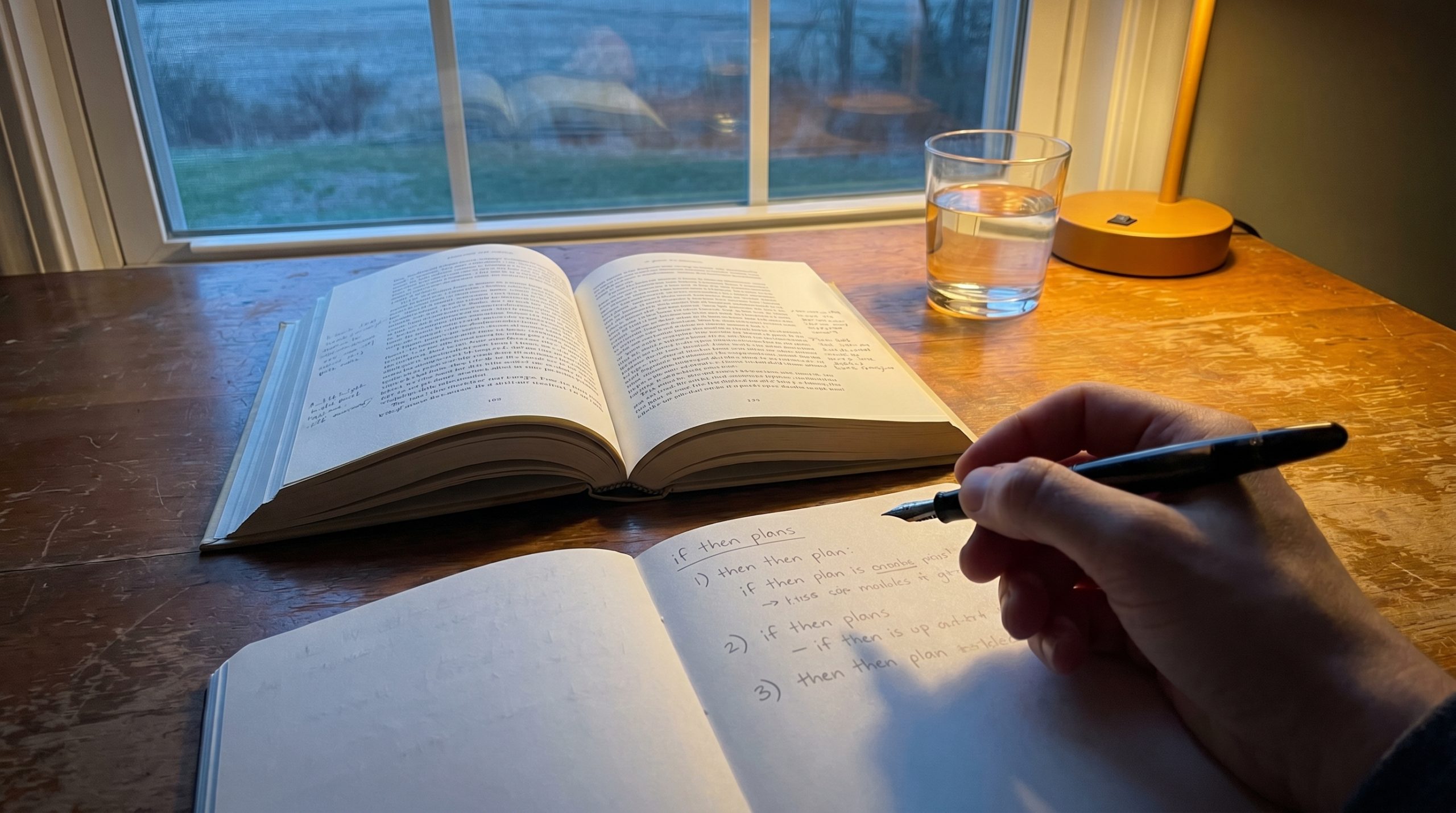
Sunday evening. He sits down. 3 books open. Five if-then plans written on a single page. The if-then format we explore deeper is what turns the page into a setup-cued reflex. Taped to the monitor. “If [setup-X observable], then close the platform until the second hour.” Five plans. 3 books.
5 weeks later the X-setup pattern has not repeated. Not because the trader got more disciplined. Because the plan triggers the skip. The plan triggers it before the trader notices the setup is even there. If-then is the line between the page and the trade.
The Read-to-Apply Protocol
1 Book / 1 Mechanism / 1 Week
A book is not finished when the last page is turned. A book is finished when its core mechanism has run through five live trades. The core mechanism is the one sentence the author repeats across the chapters. One Mark Douglas book carries “anything can happen, every moment is unique” as its spine. One Steenbarger book carries the daily-process journal. One Van Tharp book carries position-sizing as risk-of-ruin. The trader who reads 3 books in 30 days has read zero books. The trader who reads one book in 30 days and runs its mechanism through fifteen live trades has read it.
Write the If-Then Before You Close the Chapter
When a mechanism shows up in the reading, the plan gets written immediately. Format is fixed. “If [observable setup-condition], then [concrete action or concrete skip].” Bad: “be more disciplined when revenge-trading.” That has no setup-trigger and no action. Good: “If I have a losing trade in the first session, then I close the platform until the Recovery-Hour.” That has both. Five to 10 plans per book. More is theater.
Spaced Recall Before the Open
Sunday evening, 30 minutes, all active if-then plans recalled without the book. What does not get recalled is not in the setup-reflex yet. What gets recalled 3 Sundays in a row is in the reflex. The discipline-quota that shows up on the wrist reads it the same way. The Sunday recall is for retrieval, not for re-reading. The recall is for retrieval. The recall is not for review.
Re-Read on Pain Trigger, Not on Schedule
Re-reading on a monthly schedule is highlighter-theater. Re-reading after a trade has violated the mechanism is encoding. Pain triggers encoding. Pain without re-reading repeats the loss. Re-reading without pain rebuilds the highlight. The trigger is pain. The trigger is not the calendar.
The Math Is The Same On Every Continent
The books are not the problem. The other side of the same answer is the post-trade journal-format that turns Sunday reflection into Tuesday discipline. The books are the right answer to the wrong question. The wrong question is “which book do I read next?” The right question is “what from the shelf have I not applied yet?” Year-3 traders read fewer books and finish them harder. Year four happens or it doesn’t. The Apply-Quota decides. The Apply-Quota decides what kind of trader walks into the morning session 3 years from now.
Find Your Reading Trap
The Apply-Bug looks different by profile (Impulsive skips the if-then, Overthinker writes fifty, Burnout forgets the Sunday recall, Undisciplined keeps no schedule). The Peak Performance Trader assessment shows which one is running. 10 questions. 2 minutes. Take it when you’re ready.