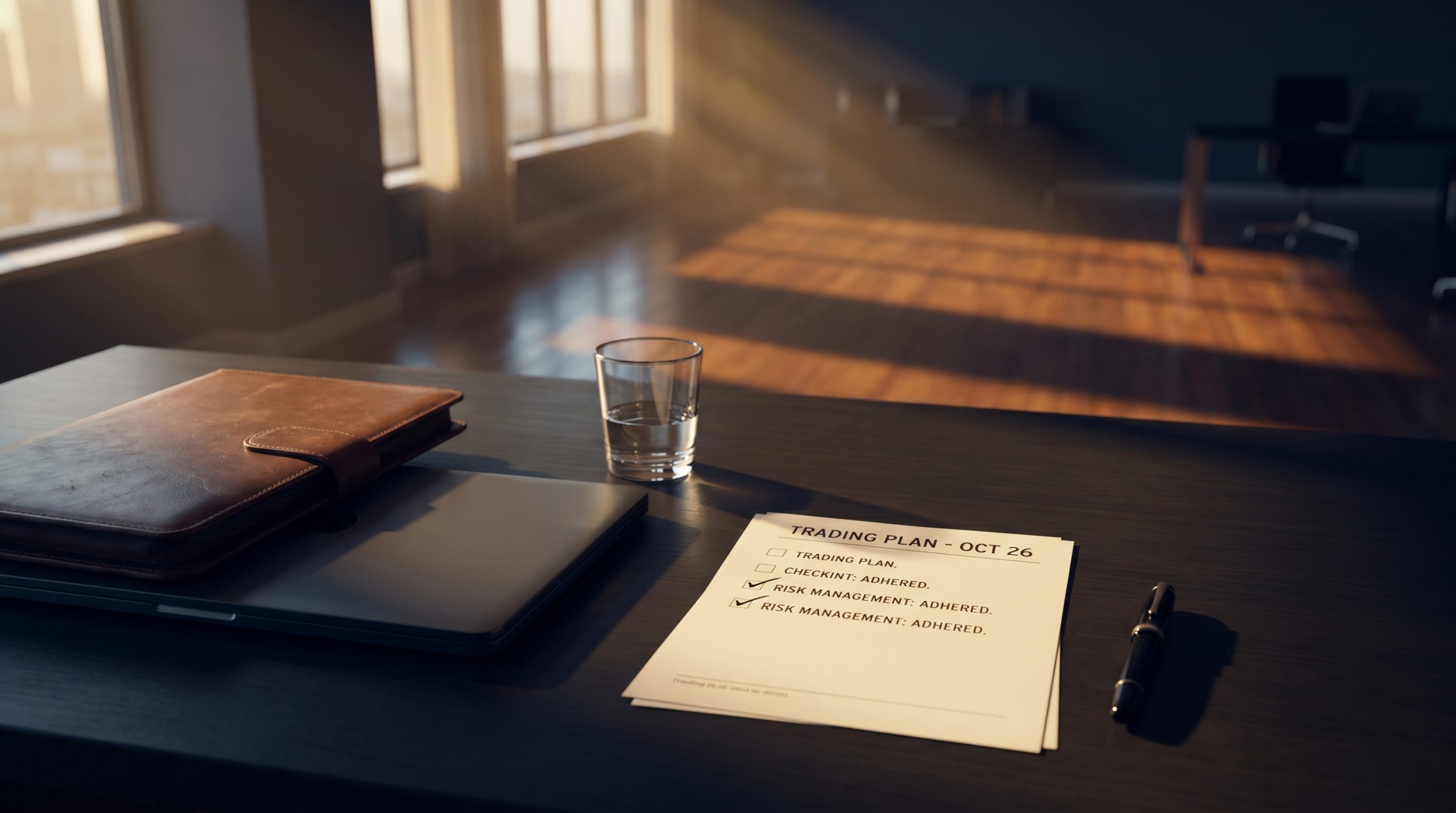
80 minutes into the New York session. 2 trades down.
The screen still bleeds. The plan from this morning is on the desk, untouched. The finger is half on the buy button.
Most traders take the next trade. The next trade isn’t the problem.
The next 60 minutes are.
Cortisol is still climbing. The brain that picks the next setup runs on the same chemistry that lost the last two. Recovery isn’t optional. Recovery is the mechanism.
Why The Next 60 Minutes Cost More Than The Loss
Most traders don’t lose to bad setups. They lose to the next 60 minutes.
The first hit is rarely the damage. The damage is what happens after. The second trade taken on a body that hasn’t cleared the first one. The third one taken to fix the second one. By the time the chart is closed, the loss is no longer about the setup. It’s about the chemistry that took over after the setup failed.
Most trader drawdowns aren’t caused by the entry that lost. They’re caused by the 3 entries that came after it.
The damage isn’t in the loss. The damage is in the chemistry that follows it.
The Mechanism Behind The Recovery Hour
Cortisol has a half-life of about 60 minutes.
That number isn’t a coaching slogan. It’s an endocrinology fact. After a stress event, cortisol climbs in the bloodstream and takes roughly an hour to return to baseline. A losing trade counts as a stress event. During that hour, risk perception, threat detection, and reward sensitivity are all running on a chemistry that’s tilted away from clean decision-making.
Coates and Herbert, 2008 sampled cortisol from real London traders across eight consecutive trading days. Cortisol rose with trading variance and with market volatility. The traders who stayed in the chair through that variance were running their next decisions on a measurably different physiology than the one they’d started the day with. The body is on cortisol. The body is on cortisol whether the trader keeps trading or not.
The dopamine side compounds it. Volkow and colleagues, 2011 describe negative reward prediction error: when the expected reward fails, dopamine doesn’t just stay flat. It crashes below baseline. The brain registers an error signal and starts pulling toward whatever might restore the reward. For a trader, that means the next setup. Discipline didn’t fail. Discipline can’t override a striatum gradient while the cortisol curve is still climbing.
This is the same brain on cortisol that drives the third hour of any trading day. Different time. Same chemistry. On a sleep deficit, the curve starts higher and the recovery hour stretches longer.
Recovery isn’t a discipline question. It’s a clearance time.
What The Recovery Hour Actually Looks Like
I’ve watched this exact loop in a trader this year.
80 minutes into the New York session. He’d been at the desk since six. Two hits. The first was a clean stop. The second was a forced re-entry on a setup that didn’t really qualify. The screen still bleeds. The plan from this morning is on the desk, untouched. The finger is half on the buy button.
The exhaustion was already there before the first hit. The window had closed 2 hours ago anyway.
He stood up. Walked out of the room. No phone. No charts. 60 minutes minimum.
He came back an hour later. The market hadn’t moved much. The setup he’d been about to take before the break was still on the screen.
It didn’t pass his criteria. It was a forced setup. He saw it now. He’d been chasing the loss, not the edge. He saw it because the cortisol had cleared.
He didn’t take the trade. He closed the platform by session close and went to dinner.
The next morning was the second-best trade of the month. The body had cleared, and the wrist showed it. Morning HRV is the body’s readout of whether yesterday’s recovery hour worked.
The Work
The recovery hour has 3 steps. Skip any of them and the hour was just 60 minutes of waiting.
Stop the screen
Physically away. Tablet closed. Phone face down. Minimum 60 minutes. The timing matters most after the first red of the session, which is why the first loss is the loudest signal of the day.
Not fifteen. Not “I’ll just check in.” Not a partial trade as a bridge.
Cortisol has a half-life. The trader doesn’t override the half-life.
The body is on cortisol. The body is on cortisol until it isn’t.
Reset the body
Walk. Outside. 15 minutes minimum, no treadmill substitute. Sunlight matters more than step count.
Water. Three hundred to five hundred milliliters. Most traders are mildly dehydrated by late afternoon without noticing.
Box-breathing for 60 seconds. Four in, seven hold, eight out. Through the nose. The vagus nerve responds to slow breathing the way the cortisol curve responds to time.
No charts during these 60 minutes. No Discord. No Twitter. The brain needs absence of input, not new setups to chew on.
Recovery is physiological. Recovery is physiological, not philosophical.
Audit before re-entry
3 questions on paper before any new trade is even considered.
What was the setup that caused the loss? One sentence.
What did I miss? One sentence.
Does my current setup meet my edge criterion? Yes or no. Not “maybe.”
Hand-writing engages the prefrontal cortex in a way that thinking-about-it does not. Notion works. A napkin works. The point is the writing, not the medium.
If the audit isn’t possible, the trading day is over. Too emotional. No clear setup. The answers won’t come. Tomorrow.
The next trade isn’t the recovery. The next trade is the test of the recovery.
You Are Not Weak. The Chemistry Is Real.
Most traders skip the recovery hour.
The first hit looks like bad luck. The second hit looks like persistence. The third hit is the system telling you what was true after the first one.
Sitting still while the screen calls is harder than taking the next trade. The screen feels like the answer. The screen is the problem.
The recovery hour isn’t a soft step. It’s the hardest 60 minutes in a trading day.
It’s also the difference between a year-three trader and a year-four trader. The few who make it past year three aren’t the ones with better setups. They’re the ones who learned what to do when the setup failed.
Take The Test
If recovery hours look harder than the trades themselves, the test below maps which type of trader you’re running (Impulsive, Overthinker, Burnout, or Undisciplined). 10 questions. 2 minutes. Take the assessment. Take it when you’re ready.