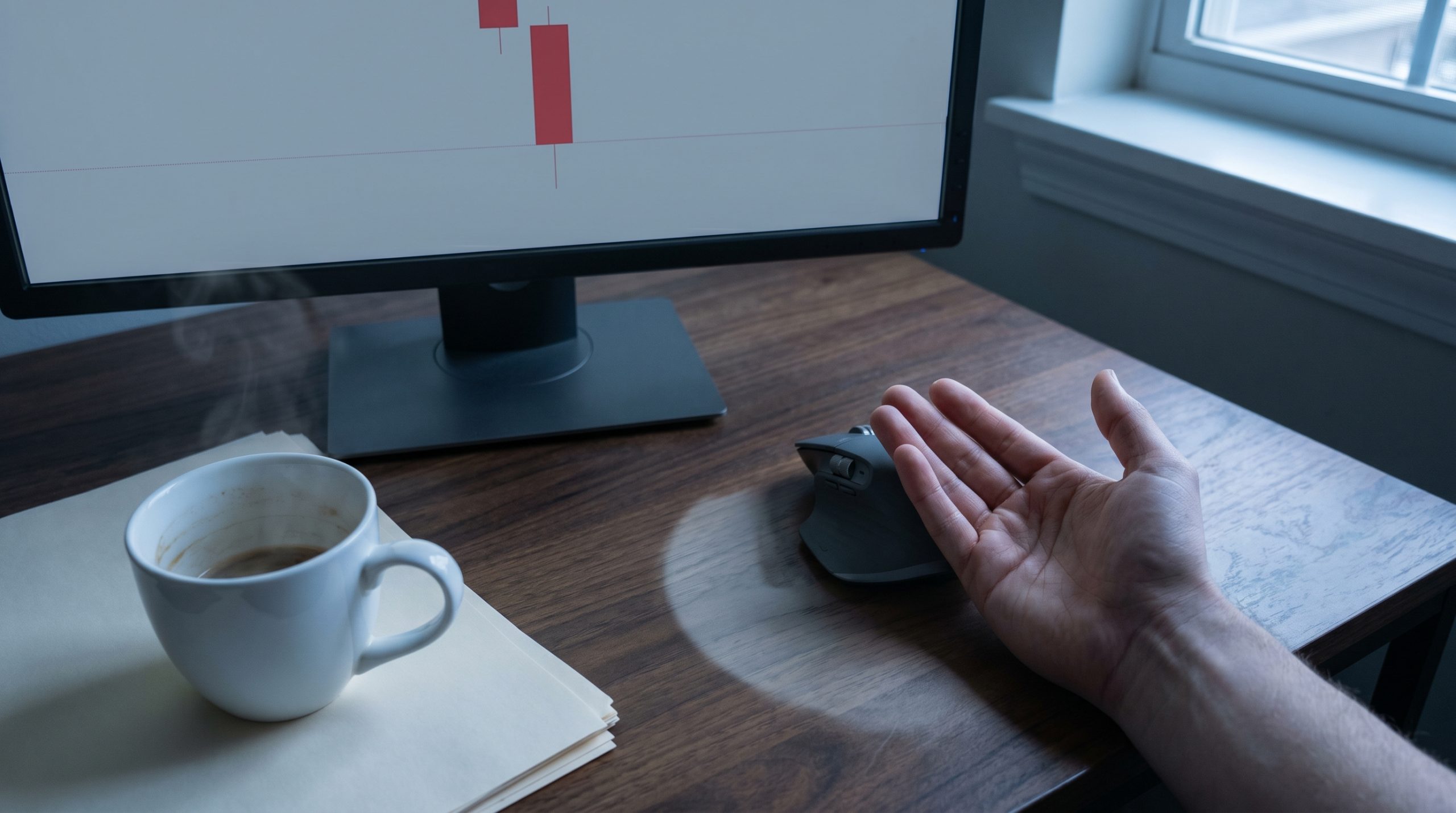
The trade closes red 47 minutes after the open, and the hand reaches for the next setup before the brain finishes reading the result.
The reasoning sounds rational from the inside, because the market owes the day a recovery, the setup looks fine on the chart, and the size is bigger than the morning plan said. The next trade is not a trade. The next trade is a chemistry experiment running on a single-trader budget.
Revenge is not the problem. The problem is that the brain is still on the last loss.
Why The Next Trade Looks Different From The Plan
The loss opens a 15 to 30 minute window in which the brain stops doing probability math, and cortisol and heart rate climb together while the next trade gets selected inside that window. A trader who does not know about the window reads the tilt-state as a discipline failure, even though it is closer to pharmacology than to character.
The cost of not seeing it shows up in four places. Revenge trades get filed under character weakness instead of cortisol peak, even though the timing is reliable to the minute. Position size rises in the exact moment when the risk-assessment system is chemically muted, which is the worst possible coincidence. Drawdowns are not built in one trade but in three to five back-to-back trades within the same hour, all selected by the same chemistry. And self-image takes a hit (*“I cannot handle losses”*) even though the system has a real, time-limited limitation.
There is a reason the second trade looks different from the morning plan. The brain that picks it is not the brain that wrote the plan.
The 30-Minute Window The Body Opens After A Loss
Three pieces of research describe the window in different layers.
Layer 1, Cortisol And Heart Rate Rise Measurably During Gambling Losses.
Krueger, Schedlowski and Meyer (2005) measured salivary cortisol and heart rate during casino gambling in 51 healthy participants (Krueger et al. 2005). Cortisol levels rose with the onset of gambling and stayed elevated through the session. High-impulsivity subjects showed significantly higher heart-rate levels than the low-impulsivity subgroup. The tilt-state is not metaphorical. It is detectable in saliva and pulse.
Layer 2, Within-Session Chasing Is A Behavior Pattern, Not A Strategy Failure.
Brevers, Bechara, Hermoye and Cleeremans (2022) tracked within-session chasing in online gambling (Brevers et al. 2022). After losses, the probability of follow-up bets rose measurably. The pattern was not driven by bad strategy. It was driven by the physiological state in which the next decision got made. The revenge trade is not the next trade. The revenge trade is the trade that gets picked while the cortisol is still rising.
Layer 3, Reappraisal Reduces Risk-Taking In The Acute Phase.
Heilman, Crișan, Houser, Miclea and Miu (2010) showed that cognitive reappraisal before a risk decision reduced both behavioral risk-taking and the matching prefrontal cortex activation (Heilman et al. 2010). The window cannot be skipped. The behavior inside the window can be turned down by a reframing tool.
In the pillar piece on hour-three blowups, the prefrontal cortex runs out of fuel by the afternoon. Here it is the opposite problem. The PFC has fuel. The amygdala is just louder than the PFC for the next 30 minutes after a loss.
A smoke alarm gives a 90-second alarm tone even when the toast is only mildly burnt, and during those 90 seconds, every decision sounds like an emergency decision. The cortisol peak is the smoke alarm of the trading day. The loss is the burnt toast. The alarm is not the fire.
A Trader Who Lost 7R In 90 Minutes Did Not Lose To The Setup
Wednesday morning session, London open, and the first trade runs cleanly into the stop for a 1.5R loss. The account stands at minus 1.5R after 47 minutes of trading, which is fine on its own and would end any normal day right there.
The hand is already on the mouse for the next setup, even though the setup is not in the morning plan. Position size goes to 1.5x because *“the first one was too small, otherwise it would have worked,”* which is the reflex of a brain that does not know it is in a cortisol peak. The stop hits after 12 minutes, and the account stands at minus 4R.
The third trade follows the same pattern at position size 2x, entered on the 5-minute chart without higher-timeframe confirmation. The stop hits after 8 minutes and the account sits at minus 7R, 90 minutes into the day.
The pivot is not Thursday. The pivot is Wednesday evening, when the trader opens the journal and does not write down the setup mistake. He writes: *“How did the first loss feel before the second trade got selected?”* The answer is one word, *loud*, and louder than any gain on that day would have felt. The second trade did not get selected. It got reacted.
Thursday morning session, the first trade runs into the stop again for 1.5R, but this time a hard rule arrives between the stop and the mouse. 15 minutes screen-off, then look at the next setup, and let the cortisol peak fade in between. The next setup did not come, and the day ended at minus 1.5R. The first loss is not the problem. The trade that gets selected inside the loss-aversion window is the problem.
Five Rules For The Brain At Minute 48
Step 1, The 15-Minute Rule After Any Stop-Out.
When the first trade of the day runs into the stop, 15 minutes of hard screen-off follow before any setup engagement or watchlist movement is allowed. Krueger 2005 documents the cortisol-spike window, and pharmacology shows the peak fades after 15 to 20 minutes, which means the rule is not discipline but pharmacokinetics. This is also the first if-then card that survives the cortisol peak: *if first trade red, then screen off for 15 minutes.*
Step 2, The Reappraisal Sentence Before Re-Entry.
Before any trade after a loss, one sentence gets spoken out loud: *“This trade is one of two hundred this quarter. Not one of one today.”* Heilman 2010 shows that exactly this kind of reframing reduces risk-taking in the acute phase, which means the sentence is not affirmation but a PFC trigger built into the protocol.
Step 3, The Same-Size Constraint.
After a loss, the next position size cannot exceed the morning-plan size under any circumstance. When the reflex says *“now bigger so it comes back faster,”* that exact reflex is the signal not to trade at all, because the size increase is a reliable marker for within-session chasing (Brevers 2022).
Step 4, The Two-Loss Cap Within 60 Minutes.
Two losses within 60 minutes end the trading session for the day, which means screen off, platform closed, and no re-open before the next session window. This rule is not for the third trade. It is the protection against the fourth and the fifth, which is where the real damage compounds.
Step 5, The Wednesday Evening Loss-Pattern Review.
Once a week, Wednesday evening, one question replaces a table: *“Which trade this week got selected inside the cortisol peak?”* Pattern recognition across 20 sessions reveals the individual tilt-window value, which differs between traders. Some need 15 minutes. Some need 30. Both are normal, and both are diagnostic.
The Rule That Costs The Trade That Would Have Lost More
The first time the 15-minute rule gets used, it feels stupid. The chart keeps moving, the setup looks fine, and the brake feels like it costs money. It does cost money, because it costs the trade that would have lost more.
The trader who survives the first year of live capital is not the one who never tilts. He is the one who recognized that the brain on a fresh loss is a different brain than the one that wrote the plan. The rules are not for the morning brain. They are for the brain at minute 48.
Find The Cortisol Window
Ten questions. Two minutes. The Peak Performance Trader assessment returns the trader profile that runs the room (Impulsive, Overthinker, Burnout, or Undisciplined) and where the cortisol-peak window is most likely to do damage.
Take it when the screen is off.